The first month of OTR is seldom what new drivers envision while preparing for their CDL licenses or viewing those glitzy recruitment videos. Over-the-road trucking is not akin to a burdenless motion picture; it is not an outdoor 30-days of movie-making. The primary programming of the first month is not getting free money, running really fast, or revolving; they are: getting used to things, being uncomfortable, curves of learning, and managing unrealized expectations.
This readout is purely pessimistic about what actually occurs on the road within the first month. It does not talk about the best-case scenario that could occur on a perfect trip, but what the majority of new drivers face when their life as a truck driver becomes real.
These early first month expectations confront real truck driver challenges, from uncertain going home schedules to adapting to truck stop life, forcing every CDL driver to focus on deliberately managing expectations rather than chasing idealized outcomes.
One Month as an Over the Road Truck Driver
The first week: the shock of orientation and information overload
For most CDL drivers, the first week of OTR is still partially a training period. Even though you have completed company orientation, your brain is absorbing more information than at any other time during your just-for-gig driving career.
You are learning:
- New trucking routes
- Company-specific procedures
- How dispatch communication actually works
- How long haul driving feels day after day
- What “sleeping in the truck” really means
During this phase, mileage goals are secondary. Safety, compliance, and avoiding rookie mistakes are more important than speed or efficiency. Altogether, many drivers are mentally stunned even though the miles are not high yet.
A typical OTR day in the first week feels disordered. You drive, stop, wait, get instructions, wait again, and question whether this is normal. It is.
Mileage goals: lower than expected, and that’s normal
One of the most shattered first-month expectations is mileage. New drivers often think they can drive full miles immediately. In practice, the first OTR month is marked by erratic performance and sometimes unsatisfactory figures in reality.
The reasons include:
- Learning routes instead of running them efficiently
- Dispatch limiting loads during early evaluation
- Slower trip planning
- More frequent stops
- Cautious driving in unfamiliar areas
Driver pay during the first month reflects this reality. Neatly, even if everything is “ok,” your paycheck may seem disappointing compared to your expectations. This utterly can not be a failure; it is merely the time of adjustment to the new task as a long-haul trucker.
First Month Expectations vs Reality
| Aspect | First Month Expectations | OTR First Month Reality |
| Mileage goals | Immediate high mileage | Inconsistent miles during OTR first month |
| Driver pay | Strong early paychecks | Lower driver pay during adjustment period |
| Daily routine | Flexible and dynamic | Repetitive typical day OTR |
| Trucker life | Freedom and excitement | Truck driver challenges dominate early weeks |
| Training impact | Minimal after orientation | Training period overlaps first month |
| Emotional state | Confidence | Managing expectations becomes critical |
Dispatcher communication: less personal than imagined
A lot of rookies have a vision of the dispatch as a busy place where people communicate in both directions very frequently. In reality, such a situation turns out to be more low-key and more transactional.
Dispatcher communication during the first month is a usual model that is:
- Short
- Instruction-based
- Focused on load execution
- Not emotionally supportive
Feeling it this way can seem cold at first. But it is not personal. Dispatchers handle dozens of drivers, concentrate on solving problems, and run outputting efficiently. One of the best truck driving tips is to learn to communicate clearly, briefly, and calmly during the first month.
Truck stop life: functional, not social
Truck stop life is sometimes wrongly pictured as a communing center. In the first month, it comes across more like a logistical hub.
You will visit truck stops to:
- Get fuel
- Showers
- Parking
- Food
- Basic recovery
Socializing is out of the question. The majority of drivers are worn out, focused, or they are on varying schedules. It is more important to learn how to navigate truck stops efficiently—parking, fueling, planning sleep than for conversation.
Sleeping in the truck: the hardest adjustment
Sleeping in the truck, to some people, seems to be the hardest thing while they are on the road. It is not just about being comfortable; it is about good sleep despite adverse conditions.
Some common sleep problems when driving in the first month are:
- Noise
- Temperature control
- Irregular sleep windows
- Mental overstimulation
- Difficulty shutting down after driving
A pretty big fraction of CDL drivers is usually not sleeping well at the first 30 days. This takes time to improve; it does not happen overnight. Creating a good routine beats the purchase of the best gear.
Staying home vs staying out: beliefs vs reality
Home time is yet another part where the real story sits and derails predefined expectations. Many new drivers envisage a schedule that is 100% predicable. But flexibility is practically zero during the initial time in OTR.
You could find:
- Delayed home time
- Extended staying out
- Unplanned resets on the road
- Changes to return plans
All this is the part of the process of learning about how long haul driving is done. Going home can happen, but it is not always easy or guaranteed at early on. Mood will be more uplifted and frustration dodged if one is taught how to manage home time.
Rookie mistakes: unavoidable but survivable
Every month has rookie mistakes to it. For example, missing an exit, bad parking, misjudging time, overthinking routes or under-communicating or over-communicating with dispatch.
The rookie mistakes that are made most often are rarely dangerous, but are educational instead. The crucial thing is to avoid not mistakes entirely but repeat them.
The drivers who bear the first month in their minds and who treat them mistakes as feedback and not proof of not being good for them, are the typical survivors.
A day in a typical OTR: it is repetitive, not exciting
A prototypical case day OTR in the first month is plain:
- Wake up
- Pre-trip
- Drive
- Wait
- Drive again
- Park
- Sleep
There is but one cherry on the cake, which is not in the first place even. The highpoints do not include any trouble or adventure. This is trucker life in its purest form.
The fast realization of this prevents new drivers from suffering from inadequate expectations. Most of the time, over-the-road trucking is not thrilling at all; it is just regular.
Daily Reality of the First OTR Month
| Area of OTR Life | First Month Reality |
| Typical day OTR | Drive, wait, drive again, park, sleep |
| Truck stop life | Functional stops, not social interaction |
| Sleeping in the truck | Uneven rest and adaptation phase |
| Dispatcher communication | Transactional and task-focused |
| Going home | Delays and extended staying out |
| CDL driver mindset | Learning through unromanticized answers |
Management of expectations: the true skill of survival
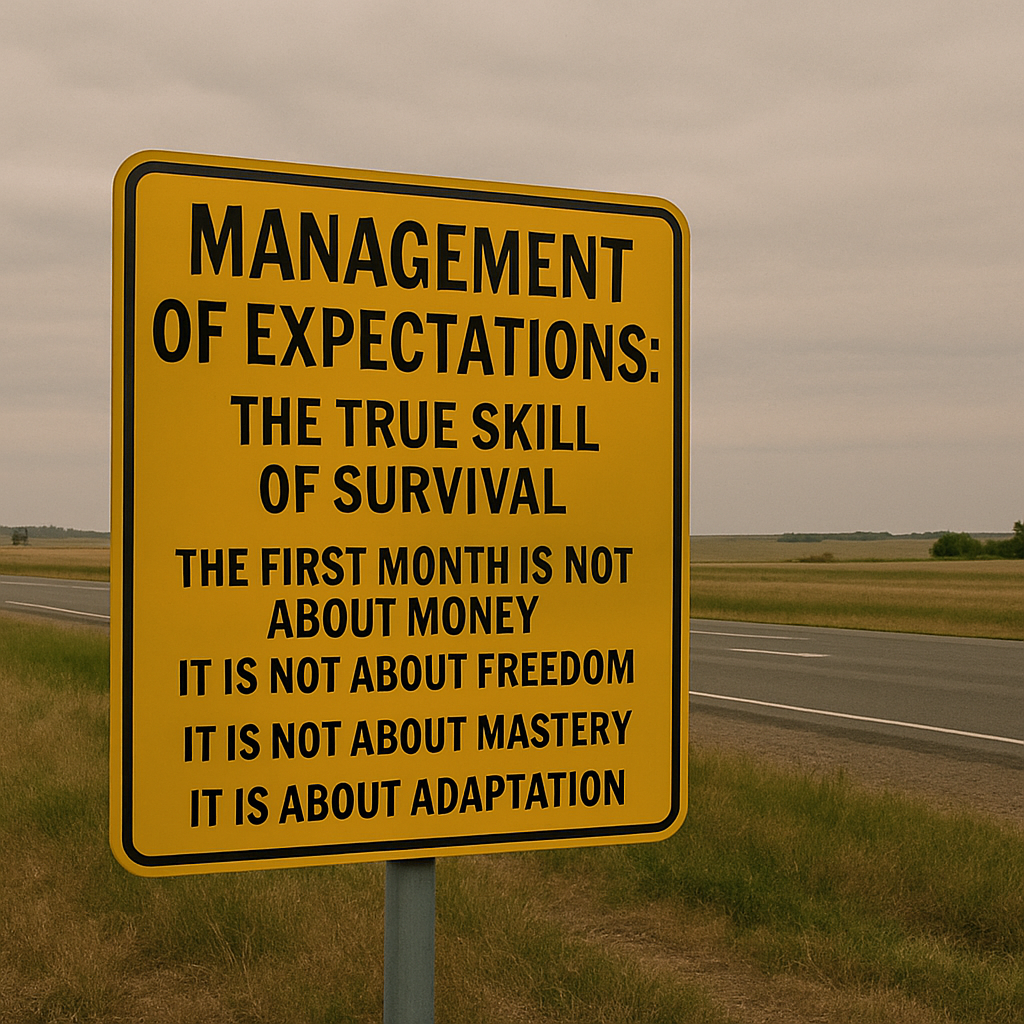
The management of expectations is far more crucial than driving skill during the first month. The drivers that quit early do not fail mechanically; they get overcome emotionally.
Unromanticized answers are the reset for the narrative of the first month:
- The first month is not about money
- It is not about freedom
- It is not about mastery
- It is about adaptation
What really becomes better after the first month
The good news is that nothing is harder than it seems.
After the first OTR month, most drivers note:
- Better sleep
- More consistent miles
- Improved dispatcher communication
- Fewer rookie mistakes
- Clearer understanding of truck driving routes
- Better control over daily rhythm
The job remains the same, but you are the one who changes.
Final remarks about the first OTR month
The first OTR month is not made to dazzle you, it is made to check your adaptability in long haul driving without the need of frequent reassurance.
The best bit of wisdom for a CDL driver entering the world of over-the-road trucking is to stay strong mentally for the first 30 days. Concentrate on learning, observing, adjusting, and do not judge the career based on the hardest adjustment period.
Unromanticized answers are not discouraging, they are stabilizing — and stability is what keeps most drivers going in their first month on the road.This mindset helps drivers build resilience, confidence, and long-term consistency beyond the first demanding weeks.
FAQ
1. What is the realistic expectation of a CDL driver during the very first month of OTR driving?
The first OTR month is primarily an adaptation period. A CDL driver is adjusting to trucker life, facing early truck driver challenges, and calibrating expectations rather than maximizing miles or income.
2. Is it common for the first month of over-the-road trucking to have low mileage?
Yes. During the first month of OTR, mileage is often inconsistent due to training overlap, route learning, cautious driving, and dispatcher evaluation.
3. In the first 30 days, how does driver pay usually look?
Driver pay in the first month may appear lower than expected because miles are still stabilizing. This period reflects adjustment rather than long-term earning potential.
4. What is a typical day OTR in the first month?
A typical day OTR is repetitive and structured: pre-trip inspection, driving, waiting, additional driving, parking, and sleeping in the truck.
5. How hard is it to fall asleep in the truck during the first month?
Sleeping in the truck is one of the hardest adjustments for many CDL drivers. Early on, sleep quality is often affected by noise, temperature changes, and irregular schedules.
6. What is the function of truck stop life in the first month?
Truck stop life during the first month is almost entirely functional. Drivers focus on fuel, showers, parking, food, and recovery rather than socializing.
7. Is going home predictable during the first OTR month?
Not always. Going home may be delayed or adjusted due to routing, freight demand, or scheduling, making flexibility necessary during the first month.