For those alongside us holding the steering wheel of professional drivers, they are more than just the people we rely on to safely fix the goods at the right time, also, they are fully involved in the timekeeping. The time spent is made up of hours in service, time to deliver, feelings of fatigue, and that panic of having a bad day instead of a good one. Whether the cause be lack of parking, shower facilities unknown to the driver, or mouth-stressing hiccups, the delivery men lose productivity week after week. Gradually, these minute deficiencies transform into exhaustion, customers skipping, and the contractors overall discontent.
In practice, saving time for a driver rarely comes from speed, but from removing uncertainty before it becomes pressure.
The model of trucking in our days has nothing to do with just the art of knowing or just the art of being local. Today, we do not have to tolerate acute losses; that is why there is a growing network of professional driver tools to solve daily problems. These gadgets, provided by the companies, do not replace judgment, but give a helping hand. If they are used properly, normatives can be heightened, the error decreased, and the driver can get back the control right on his or her schedule.
Only as practical systems that support the driver on the ground, the above article deals with the best instruments used to find parking, get to showers, and save time.
Driver time wasted due to basic logistics
Despite the cutting-edge fleet technology available, drivers still manage to spend a considerable amount of time just parking, waiting for showers, and improvising their rest plans. Truck parking is still one of the hardest and the most time-consuming issues in over-road logistics. Certainly, even expert truckers lose precious minutes searching for parking spots, arriving late, or taking unsafe areas.
In reality, most of this lost time comes from uncertainty around finding parking rather than lack of experience.
Showers are common problems which they pronate. Although there are many showers available for semi truck showers, their application is usually conditional to a lot of factors like location, time, fuel programs, and amplification of users. What should be a predictable procedure regularly takes on the form of a new uncontrollable variable.
Access to rest area showers often depends more on timing than distance, which makes planning essential.
It is not just a lack of infrastructure holding things back, but also the lack of visibility. With no fresh air congestion alone however, drivers see themselves guessing. They can only guess which parking area, rest room facilities, or which traffic would be more congested. Guessing makes them spend a lot of energy, time, and mental focus.
This is where commercial driver resources begin to matter more than intuition.
Where driver time is most often lost
| Area | Typical issue | Resulting impact |
| Parking | Full facilities, late arrival | Hours-of-service pressure |
| Showers | Long wait times | Reduced recovery quality |
| Routing | Congested corridors | Missed planning windows |
| Visibility | Lack of real-time data | Stress-driven decisions |
Parking tools as time management systems
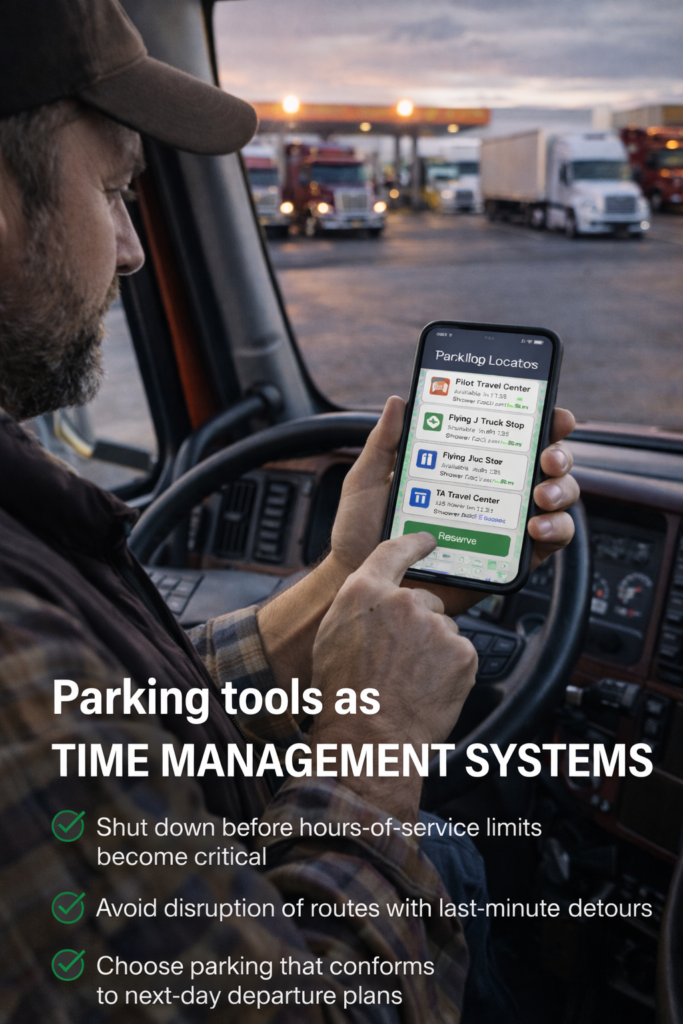
Parking tools can look simple at first sight: find a parking lot. In the real world, however, time-management and stress-reduction systems are implemented through their function. Thus, if you know parking locations beforehand, perhaps two or three hours before; this changes the course of the entire day for a driver.
Trip Planning & Truck Stop Parking
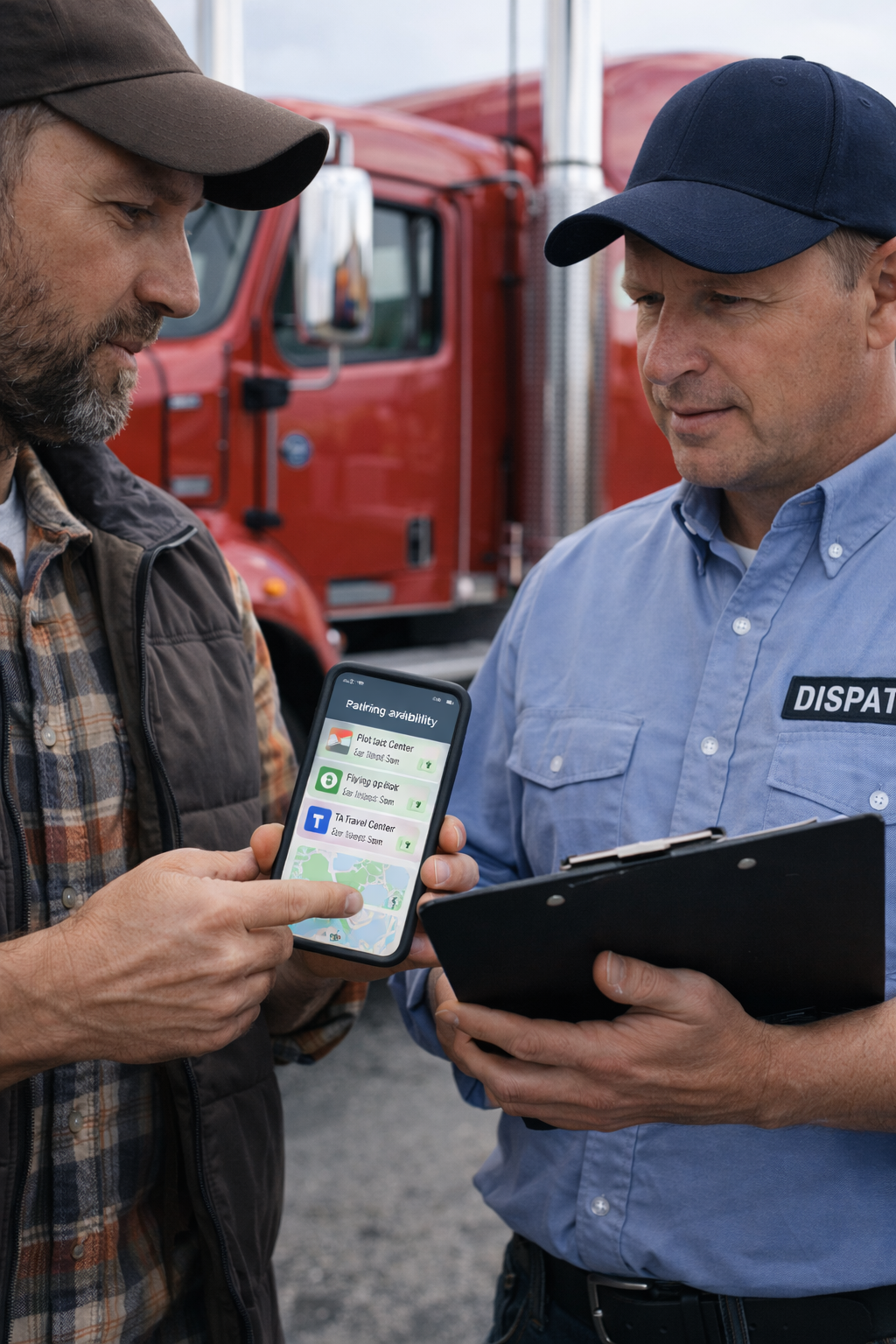
Modern parking locator tools introduce a new level in overwriting discomfort for truckers on the go. They gather data from truck stops, rest areas, and commercial lots to not only show parking availability and restrictions for heavy vehicle parking but also ensure the parking is user-friendly.
This matters, for not all parking places are equal. Length limits, overnight rules, security, and noise levels all affect the quality of rest a driver receives.
Еffective parking tools assure that drivers:
- Shut down before hours-of-service limits become critical
- Avoid disruption of routes with last-minute detours
- Choose parking that conforms to next-day departure plans
These outcomes are not about comfort, but about structured time saving tips that protect energy and focus.
The psychological benefit is just as important as the logistical one. Certainty leads to less stress, and less stress in turn improves decision-making on the road.
The role of shower tools in driver productivity
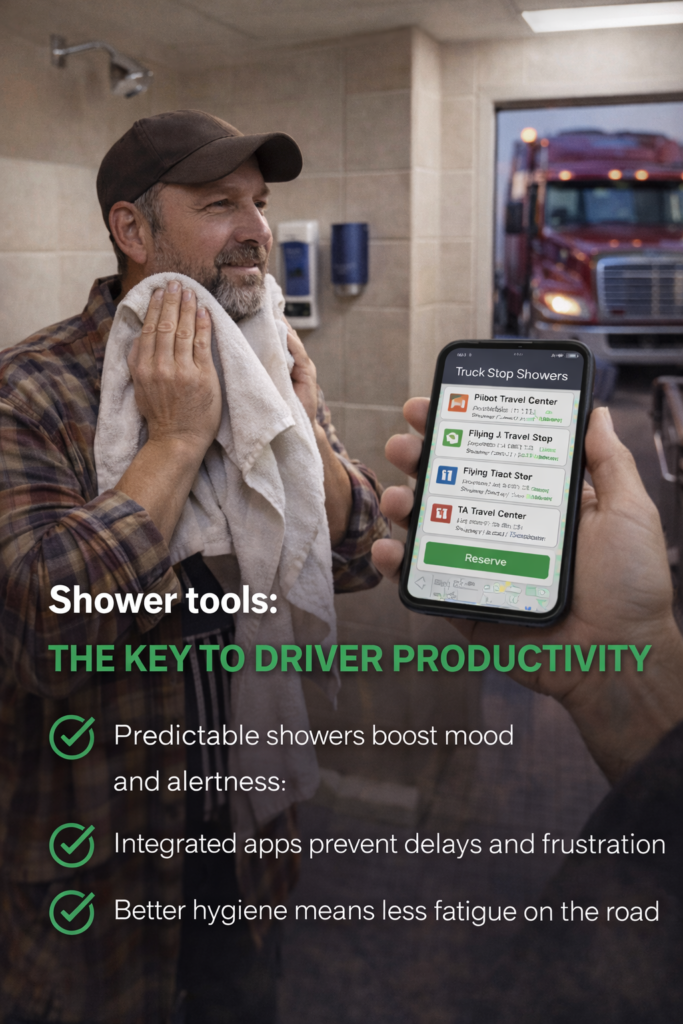
The availability of clean and predictable hygiene is often neglected when the subject of driver performance is being discussed. Shower tools are not just extras; they are powerful driver productivity tools. A driver who can count on a shower at a specific time is well-rested, has a good mood, and has better endurance during long-distance journeys.
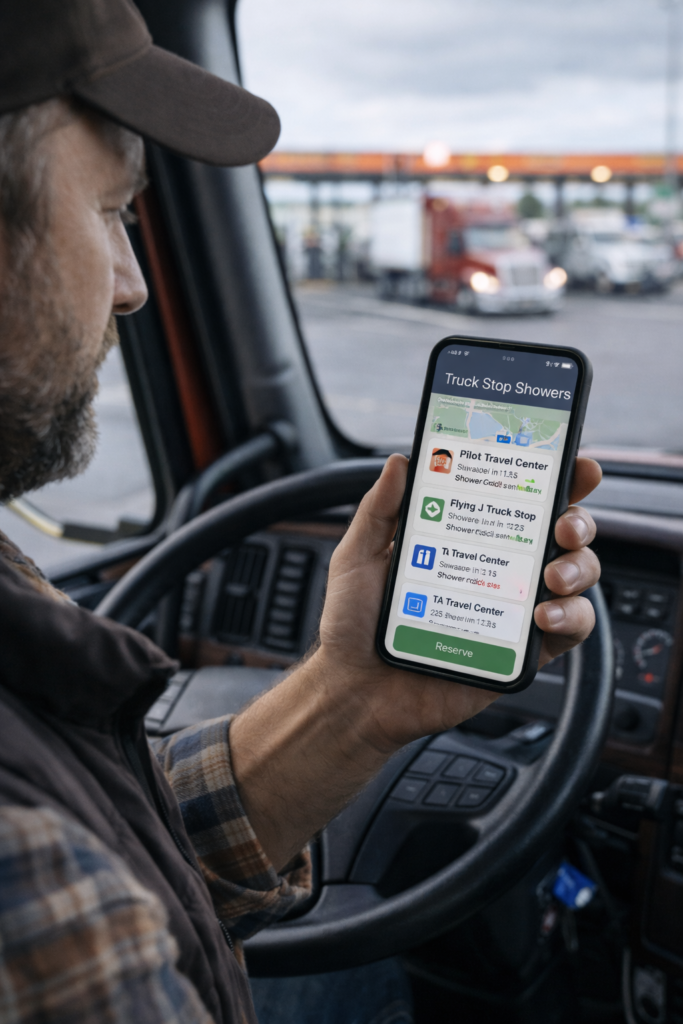
Most of the truck stop services recently integrated the shower availability feature into mobile platforms. These mobile apps for truckers are used to see the waiting times, the credit balance, and the locations of rest area and shower or private facilities. Some of the roadside services also support showing smaller, less crowded locations that drivers usually miss out on.
Besides, shower tools integrated into planning, drivers inadvertently avoid peak congestion times, and in addition, idle time is cut. That’s a direct time-saving strategy, even if it doesn’t get mentioned in the mileage report.
The best apps as operational companions, not distractions
Every time the term the best apps is mentioned, it tends to be misleading. The true worth of the app isn’t found in the long list of its features but in the way it adapts to the workflow of the driver. Those driver apps that are the most effective are the ones that remove the mental load rather than add it.
Effective logistics tools usually have the following:
- Low manual input while driving
- Visual cues that simplify decision-making
- Data that is frequently updated and reliable
- Routing and trip planning integration
When apps compete for attention, they become distractions. When they are in sync, they form a unified system for efficient travel.
How logistics tools translate into saved time
| Tool category | Primary benefit | Secondary effect |
| Parking tools | Predictable shutdown | Reduced stress |
| Shower tools | Faster recovery | Better alertness |
| Routing tools | Fewer detours | Stable schedules |
| Roadside services | Lower downtime | Preserved HOS |
Route optimization and its indirect impact on parking
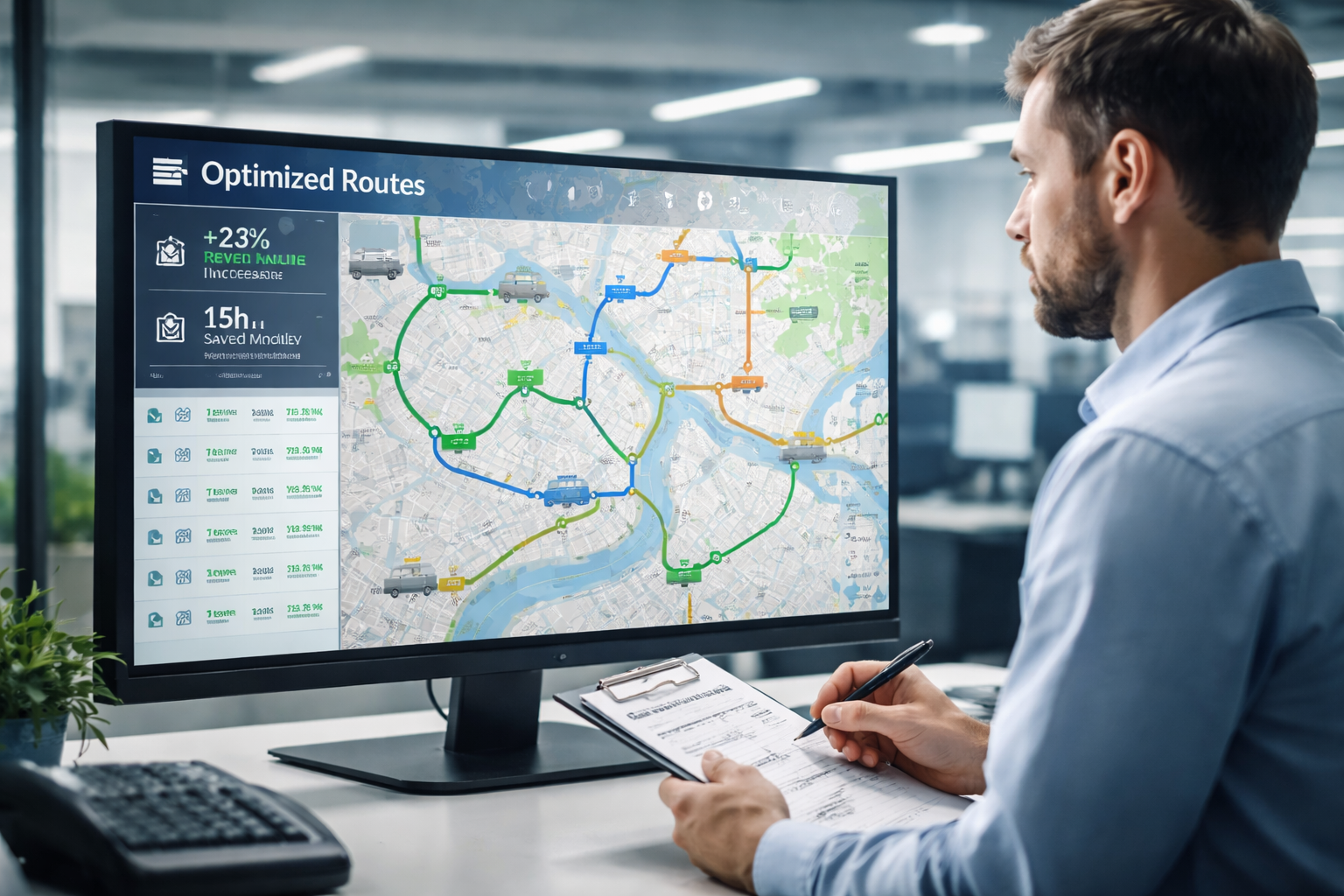
While the common routes of optimization are fuel savings or the resulting time of delivery, it is equally effective in parking and rest planning. It can be that a paper-efficient route drives the conditioners into the crowded spaces with not many parking places available.
An advanced trip planning software application not only looks at distance and offers alternate routes in traffic but also identifies choke points where the parking fills up early. It empowers the drivers by letting them alter their departure time, choose different routes, or make an earlier shut down.
The combination of route optimization and finding rest stops allows drivers to dovetail getting into parking facilities that are at capacity late in the day. This is a great time-saving trick, which relies more on planning than on speed.
Finding rest stops beyond major truck stops
Major chains are the ones mostly talked about in the parking and shower conversations, yet they aren’t the only options that one can consider. Smaller rest areas, municipal facilities, and regional service centers are some of the places that one can choose which are less crowded and quiet. The main problem is that you may not see them.
These locations are increasingly surfaced through commercial driver resources, making finding parking and rest alternatives possible even in unfamiliar regions.
This wider view of travel amenities creates a wealth of choices and at the same time, diminishes the reliance on a single huge overcrowded location.
Roadside services as time-saving infrastructure
Breakdowns, minor repairs, and unexpected delays are inevitable. What changes outcomes is how quickly drivers can respond. Integrated roadside services platforms reduce downtime by centralizing support contacts, service locations, and response tracking.
When the roadside tools interlinked with routing and parking data then drivers can make a more informed decision about where to stop safely while waiting for help. This turn prevents secondary problems, such as running out of hours while being stranded.
At this point, the roadside platforms become not only a tool to solve emergency problems but also a catalyst to boost driver productivity.
Saving time without driving faster
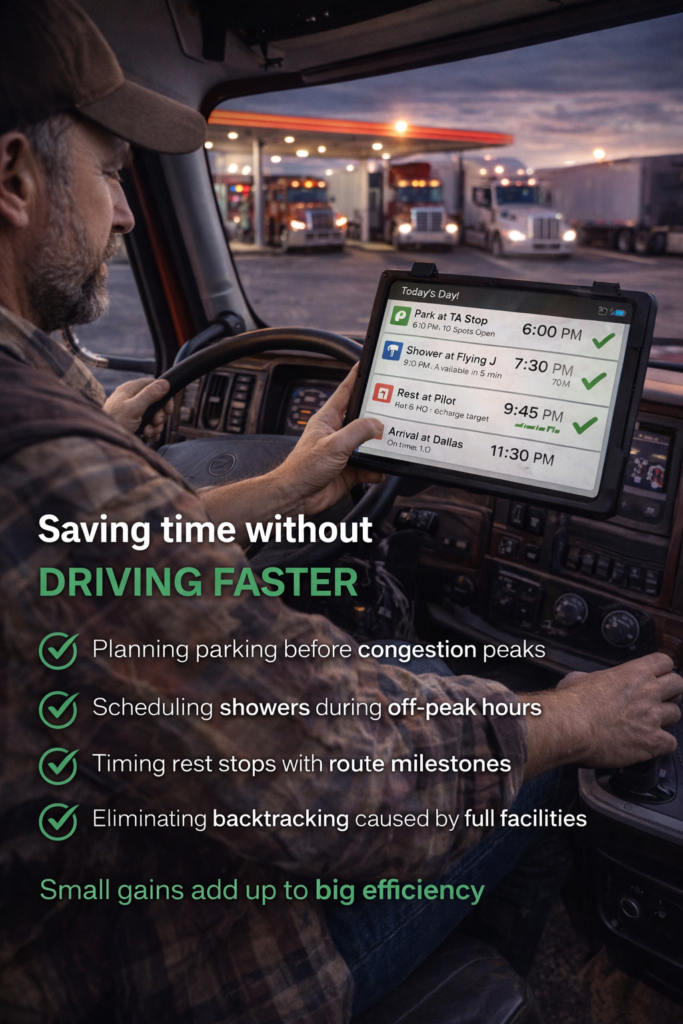
One common truck-driving experience is that the driver has to go faster to save time. No matter the pace that is taken, it is being friction that is either speeded up or slowed down. Less friction means no surprises, easy transitions, and the right sequence of actions which in turn indicate time.
To illustrate:
- Planning parking before congestion peaks
- Scheduling showers during off-peak hours
- Timing rest stops with route milestones
- Eliminating backtracking caused by full facilities
These are small but consistent gains that accumulate into long-term efficiency.
Mobile apps for truckers as personal logistics hubs
The most effective mobile applications for truckers are the ones that are hubs for personal logistics instead of functional tools. They incorporate parking availability, shower access, routing, and service locations in an organized way.
When truckers rely on a small trusted set of driving apps, the result is that the decision-making side becomes quicker and more confident. Effective travel is thus supported, while cognitive fatigue, often forgotten in safety and performance discussions, is reduced.
Balancing technology with judgment
No tool can replace experience. The tool serves to magnify but does not generate the judgment; it is you. Drivers who rely solely on apps without being aware of the environment may have problems just as those drivers who do not use tools at all.
The objective is balance. Professional driver tools should assist decisions, not control them.
The cumulative impact on driver satisfaction
In terms of functionality, shower tools, parking tools, and routing apps are solving specific objects. Overall, they are reestablishing the attitude of a driver. Reduced uncertainty causes an improved quality of sleep. Better sleep leads to better driving. Better driving translates into increased job satisfaction and longer careers.
Tools as part of a professional mindset
To use tools efficiently is to think as a professional. As drivers have to maintain their equipment and logs, managing the time and the amenities becomes a core capability.
Final thoughts on tools, time, and control
The best tools for seeing parking, showers, and time off have the same goal: gaining control back in an unpredictable environment. They do not remove obstacles but they do make it easier by reducing unnecessary friction.
With time being the most precious resource, drivers who actively seek out and adopt the best logistics tools not only save minutes but also preserve their energy. In the long term, that difference could very much translate into whether a career is manageable or exhausting.