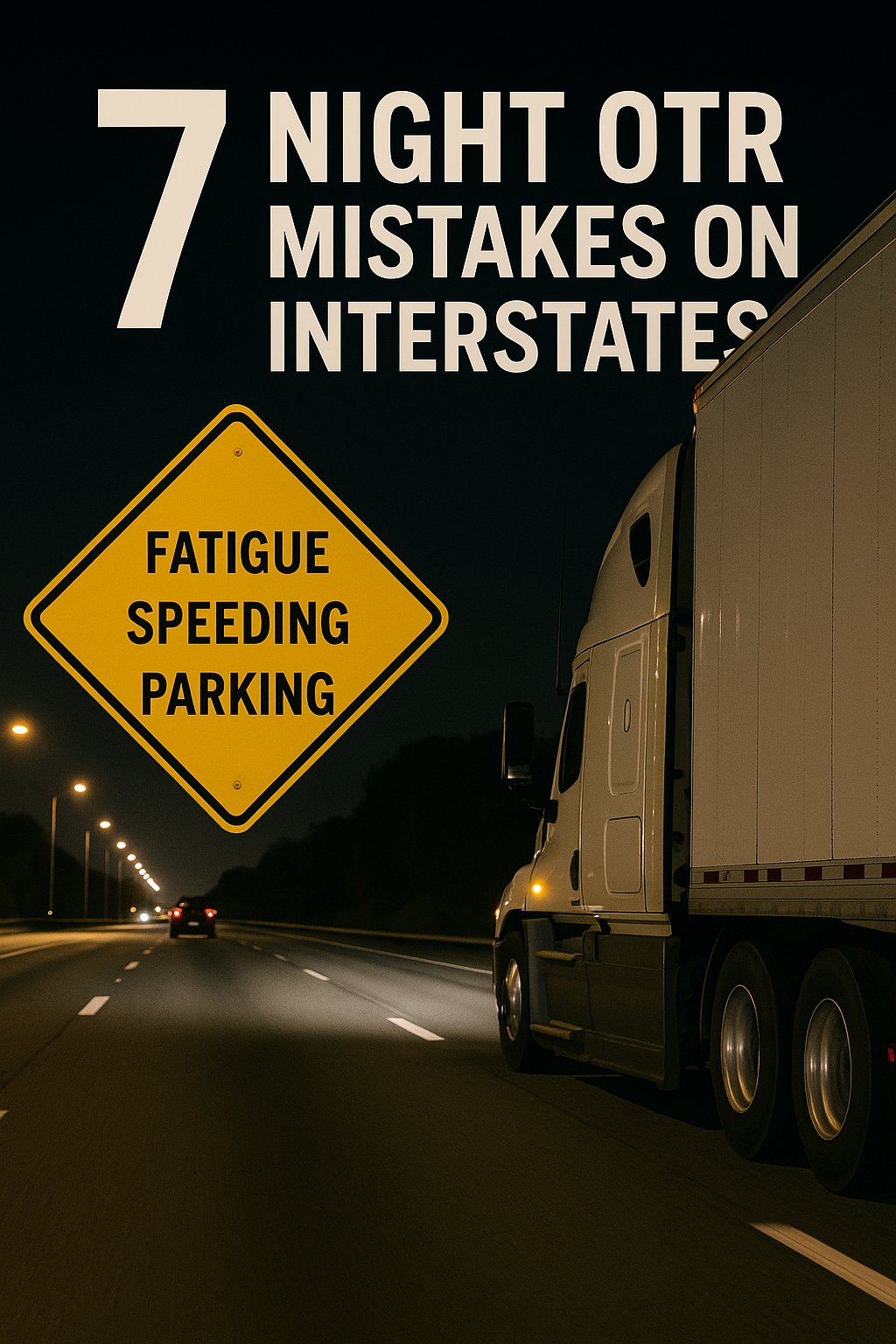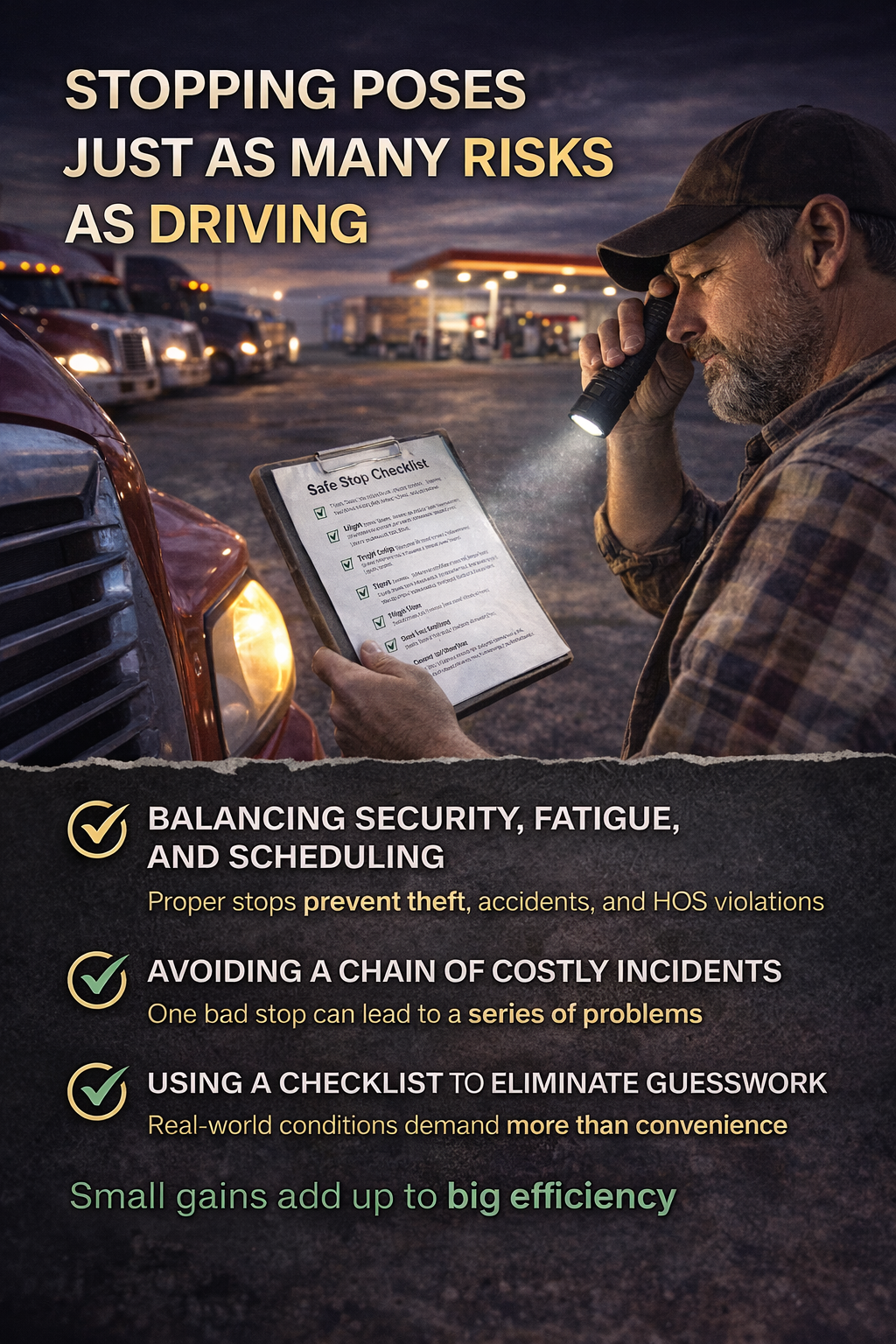
For drivers engaged in long-haul trips, it is never a neutral act to stop a truck. Every stop, whether for fuel, rest, or an overnight shutdown, introduces a different set of risks than driving. Unlike the driving that requires one to concentrate on the other vehicles, the weather, and the timing on the road, truck driver safety is mainly based on environmental, situational, and mental aspects, as the driving is no longer in motion.
In the context of long distance driving, stopping decisions often carry as much weight as the miles driven themselves.
Properly chosen stops and overnight parking are not just about convenience but rather about the driver safeguarding the vehicle, the cargo, and the ability to stay on course without any further incident. Many long-haul route problems like theft, equipment damage, mistakes due to fatigue, or compliance issues, actually begin at improperly chosen or poorly managed stops.
The article provides a practical checklist for maintaining safe overnight parking and stopping which is drafted from the perspective of the real environment of long-haul operations as opposed to ideal conditions.
The importance of both stopping and driving safely
Driving risks manifest visibly and immediately. Stopping risks are less observable and are often undervalued. For example, choosing an unsafe truck parking area can lead to cargo theft, vandalism, personal safety threats, or operating under regulatory scrutiny. Fatigue makes these risks more serious, especially during nighttime truck parking.
This is why overnight truck parking must be approached as a safety procedure rather than a routine pause.
On long-haul routes, decisions related to stopping lots are not exclusively controlled by the drivers. Delivery mandatories, time limitation, climate, and traffic all affect the decision-making process. For this reason, having a parking checklist is essential — not to slow drivers down, but to reduce uncertainty when time and energy are limited.
Safe parking is a series of steps rather than a single choice.
Describing a “safe stop”
A safe stop is a balancing act of figuring several things out simultaneously. The process is not just a matter of a free space and securing the truck, but also a combination of lighting, visibility, traffic flow, and services nearby.
The concept of secure truck parking goes beyond location and includes how predictable and controlled the environment feels once the vehicle is shut down.
The safety of a rest area primarily depends on the predictability of the environment, the frequency of monitoring it, and the behavior of other drivers.
Truck stop safety and roadside stops represent different places on a spectrum. A busy, well-lit truck stop with controlled access may be well protected than an isolated pull-off, but congestion brings risks of its own. Conversely, a quiet place for drivers to rest may feel secure, but there is no security personnel.
Evaluating rest area security requires drivers to consider visibility, activity levels, and the likelihood of supervision.
The answer is not always the same. The main aim of this checklist is to assist drivers in quickly judging the possible risks and benefits they must face.
Key Factors That Define a Safe Stop
| Safety Factor | Why It Matters | Risk If Ignored |
| Lighting | Improves visibility and deters theft | Higher theft and collision risk |
| Traffic flow | Predictable movement reduces accidents | Side-swipes and backing incidents |
| Visibility | Reduces blind spots | Limited situational awareness |
| Monitoring presence | Discourages misconduct | Increased vandalism risk |
| Exit accessibility | Enables quick departure | Trapped during emergencies |
Planning ahead: safety is a priority even before stopping
Safe stopping procedures begin well before the truck slows down. Planning is key to avoiding hasty decisions which often lead to dangerous conditions.
Key planning considerations include:
- Remaining hours before DOT limits require a stop
- Distance to known truck stops or rest areas
- Weather conditions that could change overnight
- Local patterns of congestion or enforcement
Integrating stop planning into the pre-trip inspection mindset helps drivers treat parking as part of route execution rather than an afterthought.
Good planning also includes identifying reliable truck parking locations well before fatigue limits are reached.
Checklist: selecting a safe stop location
When evaluating potential overnight parking or roadside stops, drivers should assess the following:
Lighting: Adequate lighting deters theft and improves visibility
Visibility: Clear sightlines reduce blind spots around the vehicle
Traffic flow: Predictable movement reduces collision risk
Surface condition: Stable ground prevents roll or damage
Proximity to exits: Quick departure if conditions change
These practical parking tips allow drivers to assess risk quickly when time and energy are limited.
This checklist applies whether stopping at a truck stop, rest area, or alternative parking location.
Rest area safety versus truck stop safety
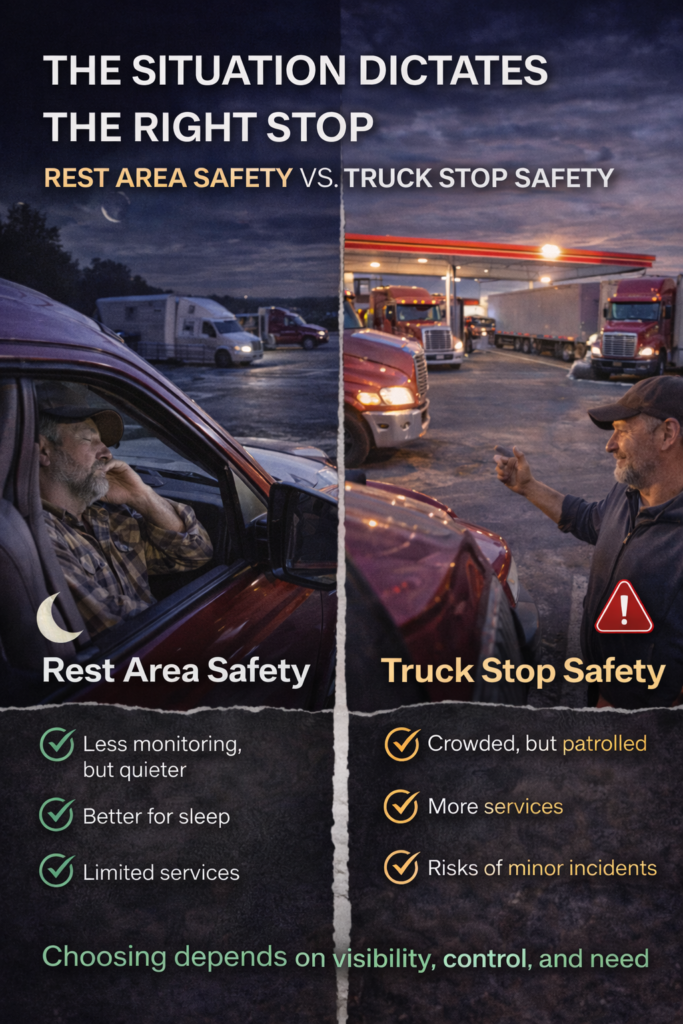
Rest areas and trucking stops have different functionalities. Rest area design and patrol frequencies are the primary determinant of how secured they are, while the safety at truck stops is found in the number of employees and their activities. In this context, truck stop safety depends not on size or popularity, but on predictability, visibility, and controlled movement around the parking area.
Rest areas may provide a more peaceful environment for the driver to get the rest he/she needs. They are considered quieter places that benefit fatigue management, but they might not have many services and the surveillance during the night will be limited.
Truck stops offer amenities and visibility, but because of crowded situations, they can increase the risks of minor accidents, confrontations, or sleeping disruption. The ability to perceive these dissimilarities makes it possible for drivers to make a choice that is based on the situation instead of a habit.
Managing driver fatigue during stops
Driver fatigue is a lingering state when the truck stops. Fatigue, in fact, makes a comeback at the end of the driving day. Unsafe parking, skipping security checks, or overlooking warning signs are often the deeds of marketers when they are worn out.
A good rest plan is one in which:
- You are not driving to exhaustion
- You already have a parking space before the last minute decision is made
- You always start the same routine before sleep
The provision of a safe rest period is a key factor for long-distance trucking that has nothing to do with a reward after it is done.
Common Stop-Related Risks and Preventive Actions
| Risk Scenario | Typical Cause | Preventive Action |
| Cargo theft | Poor lighting, isolation | Choose visible, monitored areas |
| Driver fatigue escalation | Late parking decisions | Plan stops earlier |
| Compliance violations | Unauthorized parking | Know local DOT patterns |
| Personal safety threats | Low activity areas | Trust instincts and relocate |
| Vehicle damage | Unstable surfaces | Inspect ground before parking |
Checklist: securing the vehicle overnight
Once the vehicle is parked, the security of the vehicle is the priority. As even in seemingly safe spots, routine checks will help to minimize risk.
This step focuses directly on vehicle security, which is often overlooked when fatigue sets in.
Overnight parking checklist:
- Lock all doors and compartments
- Verify trailer seals and locks
- Check surroundings before exiting the cab
- Park to limit access to the trailer doors
- Keep valuables out of sight
These few steps for checking your vehicle take only a couple of minutes, but they would substantially decrease the risk during the night through which the truck is parked.
Roadside stops: when ideal options are unavailable
Not all stops take place at the planned site. Weather, construction, or accidents may force an unplanned roadside stop. According to the Federal Highway Administration (FHWA), inadequate access to safe truck parking directly increases the risk of theft, roadside violations, and fatigue-related incidents, making stop planning a core safety concern for long-haul drivers.
(Source: FHWA – Truck Parking Safety)
These conditions call for an alert.
When stopping roadside:
- Maximize visibility when choosing a location
- Stay away from curves, ramps, and narrow shoulders
- Immediately use the right warning devices
- Stay alert for passing traffic
Roadside stops are just temporary solutions to the inappropriate parking of trucks and should not be used as substitutes for secure parking.
DOT regulations and compliance considerations
The DOT regulations dictate when and where drivers can stop. Though it may solve fatigue temporarily, parking in an unauthorized area can create compliance issues later. Balancing safety with legality is a usual dilemma.
Understanding local enforcement patterns and restrictions help drivers avoid fines, towing or forced relocation during rest pauses. Adhering to the federal regulations, safe stopping methods and procedures must include both the physical and the regulatory aspects.
Overnight parking and personal safety
A driver’s safety is not limited to the truck alone. When a driver exits the cab, uses facilitation, and interacts with others, he/she needs to be personally alert. Simply being careful can prevent most of the incidents.
Some personal safety tips are:
- Be aware of your surroundings before stepping out
- Be alert not to interact with anyone late at night
- If the place feels unsafe, trust your instincts
These simple actions support the driver’s safety as much as mechanical precautions.
Integrating safety into routine operations
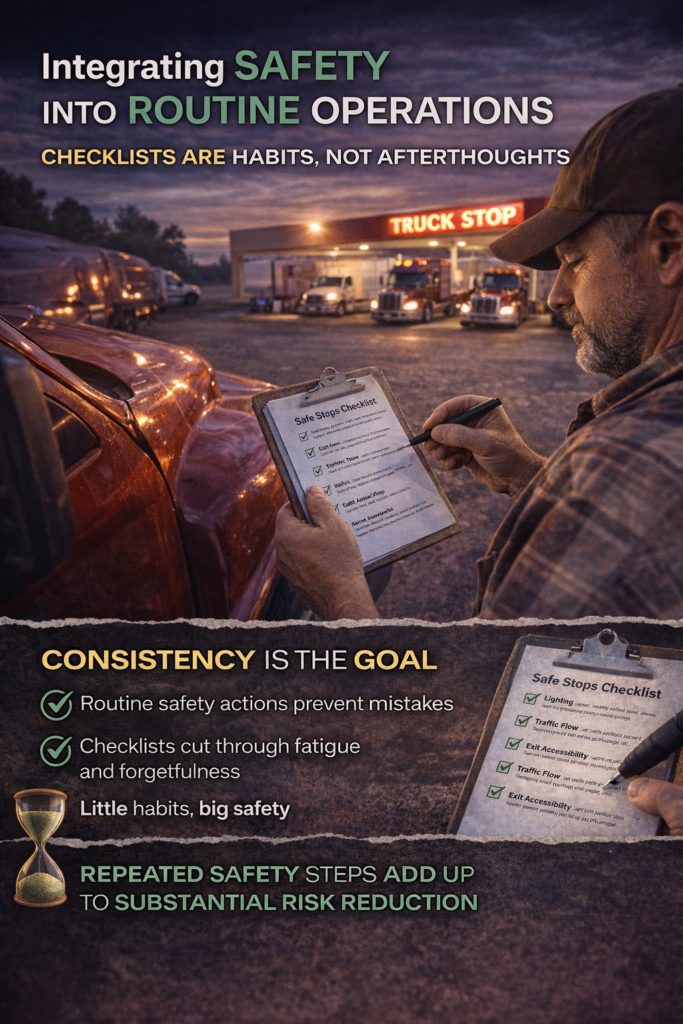
A driver safety checklist is only effective when it is habitual. Safe stops should not rely on memory alone, especially when fatigue is present. Repetition creates automatic behaviors that ensure drivers’ safety on even the most difficult days.
The objective is not to achieve perfection, but to reach consistency. Little, repeated, safety actions add up to substantial risk reduction in the long run.
Why safe stopping supports career longevity
In fact, incidents that take place during stops can often end careers faster than accidents on the road. Cargo theft, personal injury, or regulatory violations have a long-term effect. Giving priority to safe stops is the best strategy to not just one trip, but also a driver’s career.
Professional drivers who consistently make use of parking checklists and safe stopping procedures are likely to experience fewer disruptions and greater confidence during long-haul routes.
In conclusion, safe stops and overnight parking
Safe stops and overnight parking are not passive moments between driving shifts. They are active decisions that require structured thinking and awareness. On the long-haul routes, where fatigue is a non-stop and routinized thing, a checklist becomes a shield.
By following overnight parking, rest area safety, and roadside stops like a driving discipline, drivers can reduce risks, sleep better, and control their activities better.
In long-haul trucking, safety does not stop when the truck halts. It just changes its character.
The Essential Home and Overnight Parking on Long-Haul Routes FAQ.
1. What is the safety stop on a long-haul route?
Safe stop is a term that characterizes the predictability, visibility, the controlled traffic flow, and the ability to secure both the vehicle and the driver without improvisation.
2. Is overnight truck parking always at the safest large truck stops?
Not necessarily. At first, it may seem that large truck stops with many extra services and moving people are perceived as a safer place, but safety is related to layout, lighting, monitoring, and controlled movement more than size only.
3. How do decisions about stops get affected through driver fatigue?
Decision fatigue of the driver, who tired, will reduce the ability to notice danger and will affect them to make quick decisions. Thus, preplanning and following strict routines are the main commandment of safe stops.
4. What are the first things that should be checked after staying overnight at the parking lot?
First of all, the vehicle should be secure. Make sure the door locks, seals on the trailer, and surroundings are assessed correctly and limit access to cargo areas.
5. Are roadside stops acceptable for an overnight rest?
Roadside stops should primarily be considered only when no safer options are available and should never be a substitute for secure overnight parking.
6. What’s the effect of DOT regulations on which drivers choose to stop safe?
Department of Transportation rules prescribe the locations and the manner in which drivers stop, and it is thus essential to find a balance between fatigue management and compliance to avoid fines or relocations.
7. Why is it crucial to stop safely for a long-drive career?
Stopping incidents can oftentimes have a long-lasting effect and the habit of stopping safely supports both driving safety and career duration.