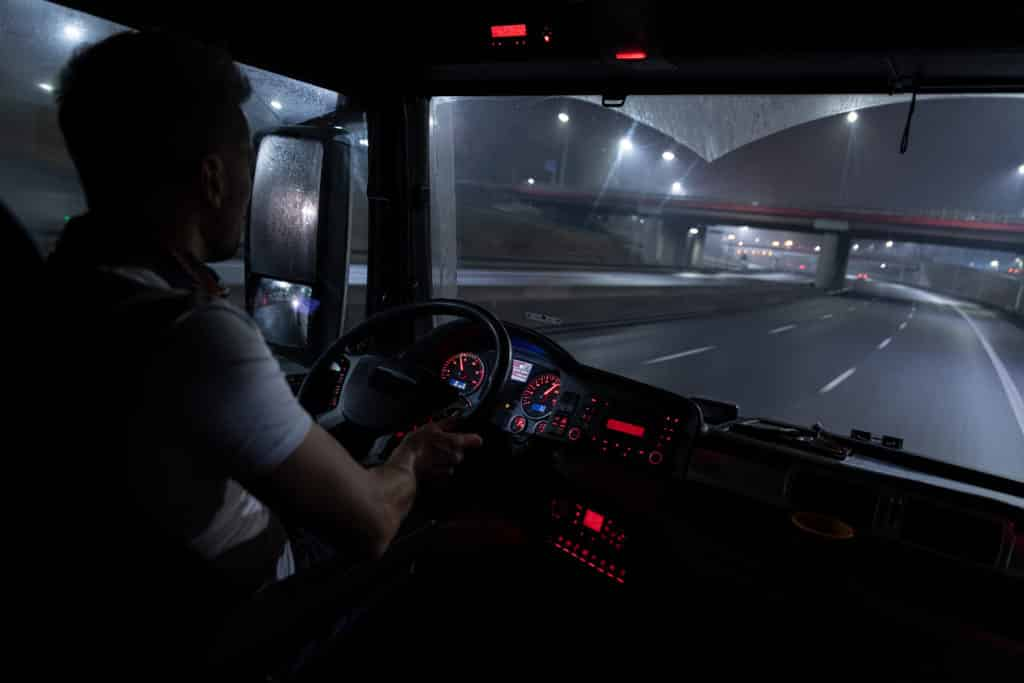
Why Night OTR Is Not Just a Schedule Change
Switching to night OTR cycles is the most underestimated transition for a truck driver. This process is often considered a simple timetable change, as if you replace daylight with darkness. But in actuality, it is a transition of a biological and operational nature. It has effects on sleep, health, decision-making, and the long-term viability of a truck driver. A sizable number of drivers choose scheduling options that are completely unsuitable and realize it far too late that adjusting themselves to night driving is not a matter of toughness or resolution. All it takes is for a person to comprehend the reaction of the bodily clock to the shifted work hours and learn about the corresponding OTR life changes such as the day driving window is switched on and off with the help of natural rhythms.
Truck driver health is one of the first things affected when night work is treated as a casual switch instead of a structured adjustment.
Adapting to night shifts works best when the driver follows a shift work strategy rather than improvising day by day.
Night OTR cycles are not capable of drivers breaking them at once. All that breaks drivers is the attempt to force night work with the use of daytime habits.
Adapting to night shifts fails most often when drivers rely on daytime routines that no longer match nocturnal driving demands.
What breaks night adaptation:
- treating night work as a casual switch instead of a structured adjustment
- improvising day by day instead of following a shift work strategy
- attempting to force night work with the use of daytime habits
- relying on daytime routines that no longer match nocturnal driving demands
Understanding Night Driving Fatigue
The first challenge in becoming used to the night shift is the absence of a state of fatigue. Night driving fatigue is not the same as the feeling of being tired after having a long day. Being a public transport driver is a systemic problem. The brain actually resists being alert when the circadian signals push towards sleep. Hence it is not a true remedy because caffeine, music, or stimulation such as that will not deal with the problem but only postpone it. The solution to the feeling of fatigue in night OTR cycles is based on structural changes rather than tricks.
Managing fatigue is not an emergency action, it is a routine that must be built into the night cycle schedule. Adjusting to night driving becomes easier when the workday is paced to protect attention instead of chasing output.
Fatigue Management for Truck Drivers
Sleep Mismanagement and Burnout Risk

Maintaining a so-called “normal” sleep schedule is one of the most common mistakes when switching to night OTR. Drivers try to sleep when they can, fragmenting their rest into short naps. They are thinking that it will help them to stay balanced. The problem is that this approach leads to chronic sleep debt, which in turn brings about worsening driver sleep problems and finally results in gradual burnout. Night shift sleep should be treated as the first priority, not as a secondary recovery activity.
Night shift sleeping must be protected as a fixed block in the sleeping schedule, not adjusted casually around operational pressure. A sleep aid for drivers should be treated as temporary support, not as the foundation of night adaptation. Avoiding burnout begins with treating sleep as non-negotiable, especially during the first weeks of transition.
Sleep and Shift Work: Implications for Worker Health and Safety
Circadian Discipline and Shift Work Strategy
The process of adaptation to night shifts starts with the acknowledgement that the circadian clock requires monitoring. The human system is programmed to make adjustments pursuant to consistent signals. The body can be more affected by the irregular sleep cycle than a shorter timeframe of sleep. Drivers who stick to a regular night cycle schedule, even on days off, report fewer health issues than those who keep switching back and forth. Trucking healthy shift work is built more on predictability than flexibility. A shift work strategy is the practical link between biological limits and dispatch reality. Without a shift work strategy, adapting to night shifts often turns into repeated resets instead of real adaptation.
| Parameter | Driver’s reference point |
| Night driving window | |
| Primary sleep block time | |
| Secondary rest window | |
| Light exposure cutoff | |
| Meal timing anchor | |
| First alertness drop noticed | |
| Second alertness drop noticed | |
| Recovery quality after shift |
Environmental Control and Recovery Habits
OTR drivers’ nights during the time when they work are shaped by what occurs both on and off the road. By controlling the light, timetables of meals, and mental decompression, drivers can have a bigger impact on their sleep management. A bright morning sky after a night of work sends a conflicting signal to the brain, thus delaying rest. Simple measures such as limiting light exposure after driving, sleeping in a controlled dark environment, and avoiding heavy meals beforehand can bring about a significant improvement in night shift adaptation without reliance on aids. Health tips for OTR drivers on night cycles usually start with light control, meal timing, and consistent recovery windows. Truck driver health improves faster when recovery habits are stabilized before mileage expectations are raised.
Productivity Illusions and Cognitive Load at Night

| Observation moment | What the driver notices |
| Start of night run | |
| First long stretch | |
| Mid-shift checkpoint | |
| Decision-heavy segment | |
| End-of-shift state | |
| Post-parking clarity | |
| Mental decompression speed |
Rearranging productivity expectations also comes with learning about driving at night. Surprisingly, night OTR cycles often appear to be easier at the beginning due to reduced traffic and quieter routes. This can create a false sense of efficiency that encourages longer runs and tighter schedules. Over time, however, the cognitive load of nocturnal driving accumulates. Decision-making slows, reaction time stretches, and the likelihood of errors increases. Night driving should be treated as a conservative planning environment, not an opportunity to push limits.
Adjusting to night driving is safest when night driving tips are based on restraint rather than early confidence. Managing fatigue becomes easier when alertness is protected the same way equipment is protected.
Clarity Over Stimulation
Many OTR driver tips focus on staying awake driving at night. This framing is misleading. The real goal is not to eliminate sleep pressure, but to maintain functional clarity. Alertness without clarity creates tunnel vision and delayed judgment. Effective night driving tips emphasize structured breaks, pacing, and acceptance of lower throughput in exchange for long-term consistency. OTR driver tips for night work consistently favor clarity over stimulation and structure over endurance.
Communication, Boundaries, and External Pressure
Social and operational pressure also plays a major role in night cycle success. Family schedules, delivery windows, and dispatch expectations are often aligned with daytime logic. Drivers transitioning to night OTR life frequently face friction between biological needs and external demands. Clear communication, boundary setting, and realistic availability windows are critical. No schedule optimization can replace proper recovery. Avoiding burnout is not only a sleep issue, but also a communication issue within the OTR driver lifestyle.
Adapting to night shifts becomes more sustainable when expectations are aligned with recovery needs.
Supplements, Repetition, and Mental Load
Health advice for OTR drivers working nights often overemphasizes supplements. While a sleep aid for drivers may provide short-term relief, body clock adjustment happens through repetition. Drivers who anchor sleep, meals, and driving windows to fixed times adapt more reliably than those seeking quick fixes. Expecting immediate comfort only increases frustration.
Driving at night also changes how drivers experience isolation and mental load. The road feels different. Longer stretches of darkness, fewer interactions, and reduced stimulation amplify internal fatigue signals. Managing this aspect of nocturnal driving requires mental structure. Audiobooks, controlled stimulation, and routine check-ins help maintain focus without overstimulation.
Final Perspective: Alignment Over Endurance

The main reason for triumphing over burnout in night OTR cycles is the regard for biological constraints. Transitioning to this shift does not aim at demonstrating toughness. Instead, it is purely about the alteration of routines in a manner that they are adapted to a specific operational reality. Those who have become accustomed to sleeping at night not only fight with their bodies but also live their lives according to them. Quitting burnout is achievable when working night is looked at as a system rather than simply a test of endurance.
Switching to night OTR cycles is absolutely not a downgrade; it is also not a shortcut to greater efficiency. Rather, it is a special operating mode. Once repeated with discipline, structure, and patience, night driving can be configured to deliver stability and sustainability. If this situation is not taken seriously, it will slowly eat away at mental and physical health.
The transition to the night operation is based on the principle of aligning-instead of resistance. The difference is only a matter of alignment. It has nothing to do with motivation.
In this case, alignment is the acceptance that the body is part of the system and not a variable that is independent of the system. Night work is the kind of work that brings to the forefront the drawbacks that daytime programs are often unawares of. Sleep structure quality, response velocity, the ability to control emotions as well as long-term health no longer find light-sight as their excuse. This uncomfortable situation is negative but very much educational. It helps the drivers to face the truth of their work mode under stress.
A certain number of drivers have a psycho view concerning fractures in which they think of the fractures as things that will heal in time and endurance which is the main driving force is known as.interoperability. But, generally, the reality is that during the period of endurance, the body just gets a break. But the adaptability comes from not enduring but overcoming the obstacles. Timely and repeated reminders along with a specific window for recovery are the foundations of night work stabilization. For example, a disciplined driver will experience some physical symptoms that are in a period of degradation before he/she has a complete breakdown.
The OTR night life is totally different in relation to the perception of time. Days are not seen through the traditional lens. Social rhythms are not allowed to move as they did before. While some others voluntarily participate in more activities, drivers who repair achieve their goals. By following the principle order, peace, and predictability are restored.
Also, in the case of alignment, there is a psychological aspect. Night driving reduces the external feedback. With the decrease of interactions, the roads become emptier, and the long period of isolation the customer forgets about the inner state. Tiredness seems to be more powerful and doubts are higher. When they lack a structure, these usually good signals tend to be bad. But, when they are arranged, they provide necessary information. Thus, drivers eventually learn how to separate the horse power limits rather than push the boundaries through overstretching.
Time on the job will ultimately determine whether night OTR cycles are feasible for long-term operation through the acknowledgment of the mode as a permanent rather than temporary interlude. Even though alignment is not the thing that makes night work easy, it surely makes it manageable. The transition from a night drive which requires a lot of willpower to a fixed rhythm with clear boundaries is the main change it goes through. In this pattern, where performance is stabilized, health is secured, and burnout is not the enemy anymore-not by power, but by design.